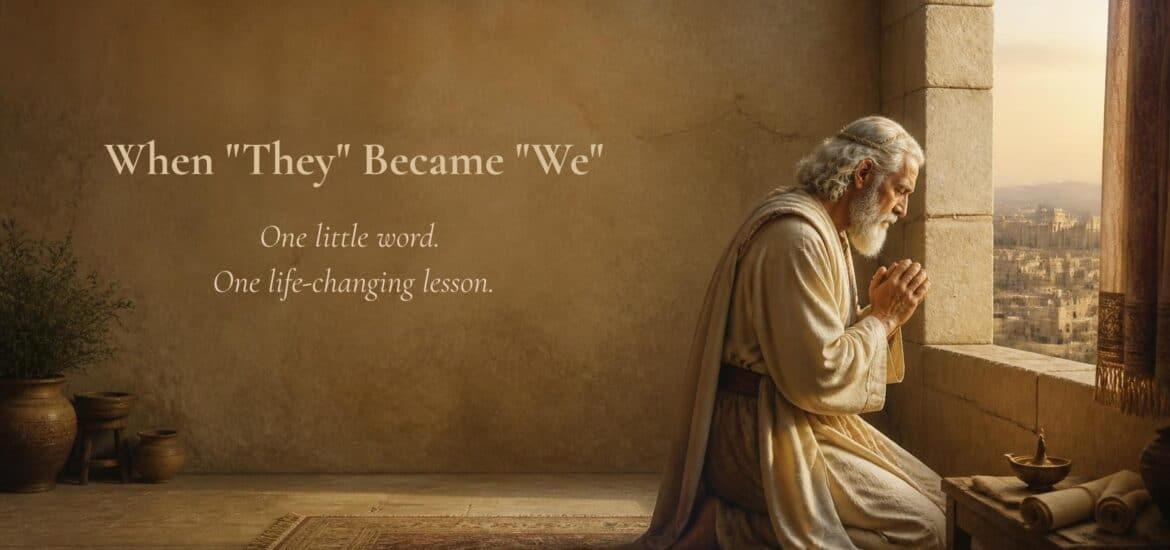
Daniel’s prayer reminds me that true repentance begins when I stop pointing fingers.
Every once in a while, I’m reading through the Bible and something catches my attention that makes me stop and think, Hold on a minute… I don’t think I’ve noticed that before. That happened while I was reading Daniel chapter 9.
Daniel had been reading the writings of the prophet Jeremiah and realized the seventy years of exile God had spoken about were almost over. You would think that would call for a celebration.
Instead, Daniel began to pray. Not a prayer of thanks,as you might think. No, he fasted, put on sackcloth and ashes, and humbled himself before the Lord. As I read his prayer, one little word jumped off the page at me.
Daniel prayed, “To the Lord our God belong compassion and forgiveness, for we have rebelled against Him.” (Daniel 9:9 NASB)
Did you catch it? Not they.
We.
That one little word made me pause because Daniel doesn’t place himself above the people he’s praying for.
Here’s why that caught my attention. The Bible presents Daniel as a man of remarkable integrity. Pagan kings trusted him. His fellow Hebrews respected him. Scripture never records any major moral failures on Daniel’s part.
If anyone could have prayed from afar, “Lord, these people have really made a mess of things,” it was Daniel. But he didn’t. Somewhere along the way, “they” became “we.”
Then I noticed something else. He keeps doing it all through the prayer.
“Righteousness belongs to You, O Lord, but to us belongs open shame…”
(Daniel 9:7)
A verse later he says,
“…to our kings, our princes and our fathers, because we have sinned against You.”
(Daniel 9:8)
Daniel wasn’t pretending Israel hadn’t rebelled. They had. He wasn’t making excuses, and he certainly wasn’t trying to soften what had happened.
But neither was he standing at a safe distance saying, “Well Lord, this doesn’t really apply to me. You need to deal with those people.”
I have to admit, that holier than thou attitude is a whole lot easier than I’d probably like to admit. It’s easy to look around at the world, shake my head at the culture, criticize the latest headline, or point out what’s wrong with someone else. Sometimes it’s even easier to do that in church than anywhere else.
Daniel chose another path.
Before asking God to deal with everyone else, he first allowed God to deal with his own heart. That to me is a breathtaking example of true humility. And maybe that’s why the next part of his prayer is so beautiful.
“To the Lord our God belong compassion and forgiveness…”
Those words land differently when you remember who is praying them.
Daniel isn’t talking about people who simply slipped up once or twice. He’s praying on behalf of a nation that had repeatedly rebelled against God. He isn’t denying their guilt. He’s acknowledging it honestly and bringing it before the Lord.
Yet right in the middle of that honesty, he reminds himself, and me, of God’s character. Compassion and forgiveness belong to the Lord. They flow out of who He is.
Reading Daniel’s prayer reminded me of Jesus’ parable of the prodigal son.
By the time the prodigal finally decided to go home, he had his apology all rehearsed. Shame had convinced him he no longer deserved to be called a son.
But he started up the road anyway. The father didn’t wait for him to clean himself up first. He ran to meet him.
I wonder if that’s where some of us find ourselves from time to time. I know I’ve found myself on that road before, if I’m being honest.
There have been seasons when the Holy Spirit has gently nudged me, not about someone else’s heart, but about my own. And I can’t help but wonder if the elder brother was a prodigal too, just in a stealth, harder-to-spot kind of way.
I don’t want shame to keep me at a distance. I want to start up the road. Because the Father is far more eager to welcome us home than we are, at times, to make the journey.
I have a feeling that’s why that little word we has stayed with me all these years. Corporate repentance begins when “they” becomes “we.”
And I can’t think of a better place than in that place of repentence to rediscover that compassion and forgiveness have always belonged to the Lord.
©2026 Katherine Walden
Sign up to receive a weekly emailed devotional by Katherine by using the following form.
