What’s the Measure of a Man?
Let’s go on a bit of an investigative hunt, shall we?
I was reading Proverbs 16:7 recently.
“When a man’s ways please the Lord, He makes even his enemies to be at peace with him.”
As I pondered that verse, my first question wasn’t: How does God make our enemies peaceful? No. My question was much simpler: What are the “ways” that please the Lord enough to bring that kind of peace?
Almost immediately, Micah 6:8 came to mind.
“He has shown you, O man, what is good. And what does the Lord require of you? To do justice, to love kindness, and to walk humbly with your God.”
Well, I got my answer right there.
As I thought about it a little longer, another thought came to mind. Micah doesn’t tell us to just do justice and love kindness. He also tells us to walk humbly with our God. I don’t think that’s just a nice little addition to round out the verse. I think humility is the anchor.
Humility keeps justice from becoming harsh and it keeps kindness from becoming a mere nicety. And perhaps it’s what keeps surface ‘discernment’ from sliding into judgement.
I don’t know about you, but if there’s someone I struggle with, maybe someone I’ve disagreed with, someone I just can’t quite understand, or even someone I find difficult to trust even though I don’t really have a solid reason, it becomes much harder to keep viewing them as an enemy.
Especially when I keep seeing justice, kindness, and humility showing up in their life. Those three qualities have a way of dismantling the walls I unintentionally built up in my own mind.
For those of us who move in prophetic circles, I think this is especially worth paying attention to. We’re encouraged to grow in discernment, and rightly so. But we’re also reminded, over and over again, to walk in humility and to not equate presumption with discernment. The more I think about it, the more convinced I become that a humble heart and discerning spirit were never meant to be separated.
Sometimes I pick up on something about a person. I might rightly perceive something that feels significant. But what I perceive and what I conclude from that perception are not always the same thing. I could have focused on only one piece of the puzzle and therefore missed the picture God was actually painting.
Perhaps they seem aloof. Perhaps I sense grief. Or maybe there’s tension in the room. I can’t quite put my finger on its source, but I know it’s there.. Those perceptions may be completely accurate. But have I stopped long enough to ask the Lord what He wants me to understand, or have I busily filled in the blanks myself?
I’ve noticed it’s surprisingly easy to point a bony finger of judgement at someone and call it discernment. If I’m not careful, I can convince myself I’m being wise when, in reality, I’m building an entire novel around a single sentence taken out of context.
I have to be honest, the older I get, the less interested I am in proving that I’m right about people and the more interested I become in seeing them the way God sees them. Too many hard lessons learned through my own lack of humility have taught me that God sees far more clearly than I do.
So, the question I ask God now is completely different that the one I used to ask. Instead of asking, “What did I perceive?” I find myself asking, “Lord, am I seeing this person the way You see them?”
That’s one reason I love the prophetic expression of digging for gold. God never called me to become an expert in other people’s hidden motivations. He called me to look for the gold because that’s where the value lies. It’s surprisingly easy to dig for dirt. Dirt usually sits right on the surface. Gold, on the other hand, takes patience, humility, and a willingness to believe that God is still at work in someone’s life.
If I can see someone genuinely seeking to do justice, love kindness, and walk humbly with God, why would I spend my time looking for evidence to support my suspicions? I’d rather look for the evidence of God’s grace at work within them.
Does that mean every broken relationship will be restored? Of course not. Sometimes reconciliation isn’t possible. Sometimes trust has to be rebuilt over time. Sometimes healthy boundaries remain necessary.
Even so, peace is still possible. Not necessarily the peace you breathe in around trusted friends, but the peace that comes when resentment is laid down, forgiveness has been extended, and both people can genuinely wish God’s best for one another and go along their separate ways.
Which brings me back to where this little investigation began.
What’s the measure of a man?
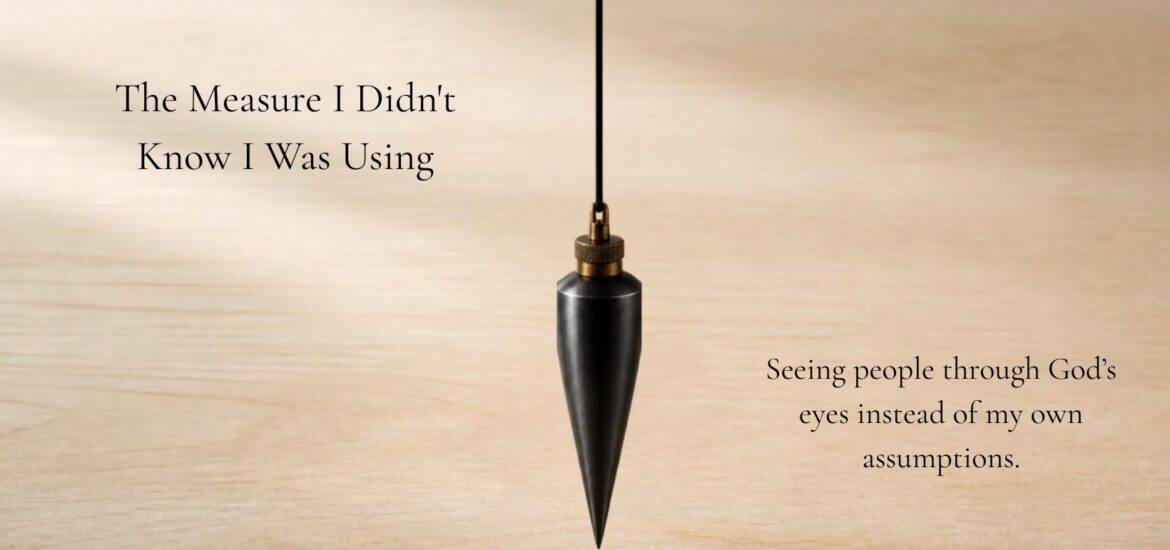
Perhaps the better question is this: What plumb line* am I using to measure them?
Am I measuring people by my first impressions? By my assumptions? By past experiences that have coloured the way I see them? By my own personality and preferences? Or am I allowing God to hand me His plumb line instead?
Justice, kindness, and humility. Pretty simple on the surface but surprisingly deep when you stop and think about it.
I have a sneaking suspicion that quite a few people I’ve placed in the “I’m not so sure about them” category never belonged there in the first place. Not because I failed to perceive something real, but because I misunderstood what I was seeing. That’s a humbling thought.Maybe that’s exactly why Micah tucked the words “walk humbly with your God” into the middle of the conversation.
Before God ever asks me to measure another person’s life, perhaps He’s first inviting me to let Him align my thoughts with the divine plumb line He’s holding.
Until next time,
Katherine Walden
* Curious about the word plumb line? It’s a builder’s tool used to check whether a wall is truly straight. It’s a tool that’s been used since ancient times and the Bible uses it as a picture of God’s standard, not to harshly condemn us, but to show us what needs straightening.
